4.30.2005

Knuckles clench to white as the landing gear retract for flight


2005-04-26, smile6, originally uploaded by lotifoazurri.


I'm off to Maryland for the weekend for my niece (seen above) Hannah's baptism. After that I'll resume regular updates, accompanied by copiously gratutious family photography. The other niece and nephew are flying up with their parents for what will be a first memorable plane ride. I expect shrieks of delight, and at least one nose pressed to the glass in anticipation of high-altitude views of patchwork farms.

Finally done with the Spring semester 2005, I never want to return to higher education. It stifles me in ways I can't even begin to describe. I regret not going to culinary school or going to FullSail for a recording degree. Oh well, you know what they say about hindsight. . .

Over the weekend I need to do some further tweaking to the comment/trackback situation that is cluttering up the space above the title. While the redesign is golden, there's still some behind the scene changes to be made, and I'm no pro.

4.27.2005

This year I ended up streamlined

It's more than a bit ironic that Charleston-based songsmith Michael Flynn admits that the soundtrack to 1983's "The Big Chill" is one of his early influences. After all, the Motown-heavy compilation that paved the way for every thematic movie score since served as the backdrop to a script about children of the 1960s who are coming to terms with the death of their idealistic youth. While Flynn's 2004 release "No Disassemble" deals with the perils of growing up and is replete with themes of love gone sour and death, its creative architect is still chasing his dream of making a living singing the songs he's written.

Growing up in Greenville, Flynn went to the College of Charleston before attending the well-respected Berkelee College of Music in Boston to further his abilities on the ivories - a skill his parents began cultivating when he was in third grade. At Berkelee, Flynn received both honors for his songwriting and began to chafe against the academic setting he found himself in. Eventually moving back to Charleston, he took with him collaborator Josh Kaler, who has played either drums or guitar for his friend ever since. They collaborated on Flynn's debut "Music for the Flood," which was the thematically expansive result of his dammed-up songwriting and arranging sensibilities, and hinted at the much tighter 2004 recording.

"No Disassemble" was written and recorded during a year in Charleston, and shows the movement Flynn has made away from the academic confines of the music establishment and into the emotional deep-end of personal experience. Flynn said that while "Music for the Flood" was written from a narrative perspective, "No Disassemble" lacked the filter that kept him from putting himself more fully into the compositions.

Recorded primarily in his bedroom, the album never ducks into the muddy instrumental depths that were the hallmark of "Music for the Flood," nor does it sound like the lo-fi effort of a beginner or an indie snob that's grown too big for his britches. Instead, Flynn uses room noises and a veritable palette of Casiotone electronic flourishes and handclaps to accent the piano, guitar and drum lineup that would otherwise be unremarkable. Sounding like a product of the IDM revolution in pop instead of a child of grunge that similar-sounding North Carolina native Ben Folds was, Flynn's literate writing and inherent sense of timing work together on "No Disassemble" to result in an understated masterpiece. Feeling never gets left behind in exchange for musical flourishes, though, and tracks like "The Sea is Never Full" and "Streamlined" show Flynn knowing when to leave out elements or extend instrumental passages in a way that is atypical of the current crop of independent artists.

"You're in Luck" finds Flynn announcing to a past love that "I know the way to your heart, you're in luck," tempting her to return to a convenient relationship. On the album's most evocative track, "Don't Let Them See Me Like This," a hollow percussive line drives the moody organ and soaring guitar that punctuate Flynn's narrative of a hospitalized love one and the helplessness he feels watching their suffering.

Although Flynn has yet to garner the critical acclaim or regional following that are stepping stones to widespread success, the building blocks are in place. "No Disassemble" is waiting for a major label to snap it up and repackage, leaving the artist and his entourage with little to do other than tour incessantly to support better promotion efforts.

When many artists dream of their faces on MTV or singing to sold-out stadiums, Flynn remains a bit more modest in admitting that his five-year plan is to make a living doing what he is now, just hopefully with a few more people in the crowd. There is already at least another album's worth of material in place, but that can wait for a more expansive touring schedule, something that might include a jaunt to the UK, Flynn said. Indeed, it seems he is finally at ease with the lineup of his band and its ability to buoy him to new creative heights. "Now I can make all the sounds I want to," Flynn said in reference to his collaboration with Josh Kaler.

Even his Charleston base seems unlikely to offer a budding artist like himself much support, but Flynn says it lacks many of the negatives common to more musically literate towns like Austin, Portland or even Boston - ease of booking shows and getting promotion in the local media. Indeed, Charleston has its own tight community of artists like The Films, Cary Ann Hearst and Bill Carson that Flynn credits for giving him creative support and encouragement. "Seeing good music like that pushes me to want to be better," Flynn said.

No longer working random day jobs like the one at Kinko's he quit in December, he plans to avoid the "black hole" that the Southeast can be for artists that manage followings here but are virtually unknown outside the region by a following stiff touring schedule. The various iterations of his band have played Columbia many times during the past three years, and fans have another chance to see him with Josh Kaler in support at Jammin' Java on Wednesday at 7 p.m. Don't pass up the opportunity to see arguably South Carolina's best songwriting talent before stardom takes hold and his perennial visits cease.

4.23.2005

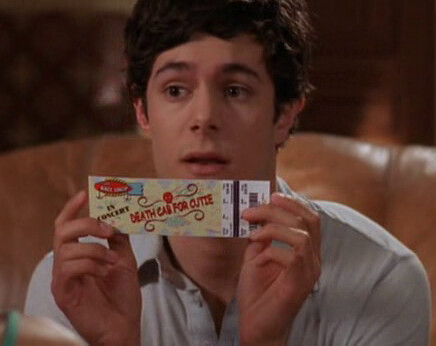
Being Seth Cohen = Priceless


Seth, originally uploaded by lotifoazurri.

Death Cab appeared on The OC this Thursday to anticipation by indie fans and the show's target audience of 14-year olds everywhere. Alas, despite getting segments of three songs in, the boys barely had 30 seconds of face time, were at a rediculously low volume setting, and had to play to a lame staged audience - and the sound guys for the show used album tracks over the visuals instead of live music.

Furthermore, the Bait Shop performance was nothing more than scenery for a drug deal plotline, hardly the kind of thing you want associated with your band. It was odd to see Ben wearing his glasses on stage, but weirder still to see a short-haired Walla playing a butterscotch Strat. New guitar? Only time will tell, although the newly revamped DCFC site has new gear listed for the fellers, undobtedly culled from the recording sessions for Plans and obligatory gear-fiddling that accompanies the band's major label debut on Atlantic.

In all, it just gives me another reason to hate the OC, with its shoddy production, scripting, and lead actors. But hey, if it sells lots of copies of Trans and lets Harmer bling out his grill in platinum, I guess it's worth it, right? Right.

4.22.2005

Adieu to the Patron

While much of the world was busy watching a chimney in Rome and debating the differences between black and white smoke, the man who is arguably America's greatest athlete in a generation quietly announced that as of July 24 he will give up the sport to spend more time with his family. Lance Armstrong is a man known as much for his efforts to support cancer research and dating pop icon Sheryl Crow as much as his unprecedented six consecutive Tour de France victories, a footnote in the sports culture of the country in which he was raised. Every July since 1999, though, he has managed to score a minor coup d'etat for his chosen profession of international-level road cycling as far as American media interest is concerned, as his lean figure is splashed across newspaper pages from Austin to Anchorage.

Saying Lance is a bike rider is like saying Jordan could play hoops or Ali won a fight or two. Understanding the man means understanding the sport, because in many ways he is the epitome of the craft he worked so tirelessly to perfect. Armstrong trains literally year-round for those 21 days in July comprising Le Tour, taking off at the most four or so consecutive days a year. A regimen of weight-lifting, eight-hour days on the bike and a diet that would make an anorexic blanch comprises Lance's year, with dozens of supporting staff monitoring his every heartbeat and calorie with the intent of delivering him healthy and hungry for victory to the starting line in France with the frightening consistency of a metronome. His rivals have called him a machine; even at the top of their form, there always seems to be a sizable difference between them and Lance, the so-called "patron" of the Tour. Clearly, this monk-like attention to detail during the year pays off when the race finishes on Paris' Champs-Elysees.

More intangible than the religious-like fervor with which he avoids ice cream and sleeping less than nine hours a night is his aura on the bike; watching him stand and seemingly dance on the pedals to climb a French col or take the wind out of opponents' attacks by bringing them back effortlessly is art in motion. Critics are fond of dismissing cycling as a fringe or an Olympic sport, but this ignores the cruel realities of Europe's third-favorite pastime (trailing only soccer and Formula One). A single stage of the Tour's daily 21 requires up to 10,000 calories, the output equivalent of running 2 1-2 back-to-back marathons. Riders deal with heat and cold, rain and snow, mangled equipment and violent crashes that break bones and bloody bodies. Lance's teammate Fabio Casartelli died in 1995 during that year's Tour after plummeting to his death off a cliff on narrow Alpine roads. Danger is ever present, even from the fans that line the roadsides so close they can touch their heroes.

It is said that to ride a single Tour takes years off your lifespan, and the riders, who commonly enter the event with body-fat percentages hovering around the ungodly figure of 3 percent or 4 percent, lose weight during the tour's three weeks. However, their loss is in bone mass from the calcium they lose in sweat on the blistering, sun-drenched tarmac of a French summer. Lance has done this six times in a row without a major stumble, every time defeating all other rivals from the 181 riders, without failing a single test for performance-enhancing drugs. The undefeated Armstrong perfected the art of doing what Americans do best - beating the other guy at his own game on his home turf, and the French hated him for doing it before being mesmerized by his dominance and panache. So thanks for being an inspiration to cancer survivors and weekend warriors on two wheels everywhere, Lance. You'll certainly be missed.

4.20.2005

She said to me as she turned on the light, there's something you don't know that keeps me from feeling right

'Crimes' by Blood Brothers
3 out of 5 stars

The old saying goes that a bad economy makes for good art, but mix in contentious politics of morality and you've got a recipe for napalm.

Seattle-based Blood Brothers prove you don't have to be a whiny guitar-picking folkie to unleash social commentary on the masses with the group's fourth full-length offering, "Crimes."

A five-piece, bass-heavy hardcore punk outfit, Blood Brothers nonetheless manage to layer tuneful guitar work under razor-wire scream delivery and sometimes-Blonde Redhead vocal inflections hiding extremely well-written lyrics.

Some people find hardcore an excuse for poor instrumentation, arranging and recording, and find it undermines any attempt at lyricism. But "Crimes" wins over even stogy critics brought up on folk with hardcore sensibilities moderated by tunefulness.

True hardcore fans will find "Crimes" easy to dismiss for these reasons, or simply after between 2003's critically acclaimed "Burn Piano Island, Burn," the Blood Brothers signed to UK label V2.

However, criticism that they mellowed out by signing to a major couldn't be more from the truth - on the record's 10th track they exhort their hoard of death's horsemen to "Prance into the halls of Congress, vomit in the speaker's lap."

This less-than-two-minute pipe bomb of a song underlines that Blood Brothers aren't for everybody, but know how to use their medium to make a statement instead of simply declaring their coolness to disaffected kids in black.

"Crimes" is a coup d'etat in its careful crafting of the Blood Brother's obvious influences - early '90s dance-punk, screamo and the art-rock of Sonic Youth and producer John Goodmanson's band Blonde Redhead.

Using subtle laptop work, keyboards, and a dual vocal delivery that is probably the most notable aspect of the band, Blood Brothers Jordan Blilie and Johnny Whitney combine falsetto screams with Droopy Dog meets Joey Ramone.

Listen to the album's closer "Devastator" to get a sense of the vocal pairing's capabilities, with a Guns N' Roses-meets-Turkish-chorus wandering all over the upper register.

The Blood Brothers admit they're pissed off by W's reascendence, and the anger bleeds through on the second track and college-radio single "Trash Flavored Trash," where they declare that "I know my addition: guns plus guns equals bang bang bang."

However, the best example of their work and the influences of Goodmanson is on "Love Rhymes with Hideous Car Wreck."

An anthem based around discarded love and accidents, the band moans knowingly that "love rhymes with pity now." Fans of middle-America dance punk like The Faint will eat up "Crimes" like the bloody postcard from the grave that it is. Just don't forget to bring your own concertina wire.

4.13.2005

Like some Orpheus descending through a turnstile underground

'Elevator' by Hot Hot Heat
2 out of 5 stars

In the world of music, it has become so much of a cliché that sophomore releases usually see bands adrift that bands like Grandaddy have used a play on the notion as album titles. Apparently though, New Wave-esque band Hot Hot Heat has done its darndest to intentionally derail any critical support it garnered after 2002's "Make Up the Breakdown." "Elevator," released last week here in the States, sees the four piece from Victoria, British Columbia mashing the up button while their lift plunges into the sub-basement.

Between their debut and the current release on Warner Bros. subsidiary Sire, Hot Hot Heat lost founding member and sole guitarist Dante DeCaro after the tracks that comprise "Elevator" were in the can, replacing him in the touring lineup with Luke Paquin.

Artistic differences, interpersonal drama or exhaustion from a stiff touring schedule aside, if your guitarist is driven away by your own new recording, it's probably not a good sign. While "Elevator" isn't technically the second album the band has produced, it was only with their previous offering that their particular brand of dance-pop garnered attention alongside indie radio neighbors like Franz Ferdinand. A diplomatic post on the band's Web site revealed that the split between DeCaro, who joined Hot Hot Heat in 2001 and was, according to the band, a major influence in focusing the noise of early efforts into something more palatable, was amiable and planned before the album's recording.

Instead of recording in raw chunks of straight studio time ("Make up the Breakdown" was recorded in six days), the band used the three years between albums and months in the studio to expand the sound that they began to pioneer on the previous album. Overall, that might have been a mistake, as "Elevator" sounds nearly as disjointed and purposeless as singer Steve Bays' copycat-of-a-male-Gwen Stefani phrasing. Essentially, the new album is driven primarily by bassist Dustin Hawthorne and the Roland-enabled variety of keyboard stylings Bays adds to his inane lyrics. Never quite able to escape the chorus-verse-chorus plague that signifies sugar-coated infective pop, Bays channels Mungo Jerry's classic "In the Summertime" on the fifth track, "You Owe Me an IOU." Managing to get past the love-or-hate vocals, listeners will find ironically alliterative lyrics that could have artistic weight given another setting. On the aforementioned track, Bays declares that "He was in the habit of taking things for granted/granted, there wasn't much for him to take." The song "Pickin' It Up" could very well be the Ramones song that never was, with a simplified three-chord punk structure that betrays some of the band's myriad influences. Proving that dance-a-billy is no place for political statements, the band has a go in commenting on what we can only assume is the war in Iraq, singing on "Soldier in a Box" that "I found a soldier in a box/A souvenir that someone lost at such a cost."

The type of "New Wave" that Hot Hot Heat is busy ripping off to sell T-shirts is hardly anything original to merit the word "new," and in a sense that is the tragedy of "Elevator." Fans of "Make up the Breakdown" might enjoy the ride, but everyone else will find these 13 tracks take them nowhere fast.